New Tool and Applications
A new free online tool, SubLin, and two new free applications, FileCut and YStickyE, are available.
Wellcome, my name is Pasquale Frega and I am a freelance IT specialist, developer / programmer and consultant of GNU/Linux systems administration and security. I started programming when I was 8 years old in BASIC on an Atari XEGS. Today I program mostly in C, Lua, Lisp/Scheme, Java, JavaScript and Bash. Read why I prefer to distribute my software under MIT/BSD, freeware, or commercial licenses, rather than GNU/GPL.
Anyone who works as a programmer at some point has to choose what are the most appropriate conditions of use for their software. Although these may vary according to the type and its users, it is still good to have points of reference. For a GNU/Linux user like me it would be natural to choose GNU/GPL licenses, but after careful reflection I decided that they are not the most suitable, and that in general they are very far from my concept of freedom. The GNU/GPLs are based on a very simple principle, that is, the software includes its source codes, so it can be modified, corrected, improved and customized, but eventually it must be redistributed in the same condition in which it was received. It would seem beneficial for the entire community, but in reality it forces choices that in the long run harm it, especially for very popular software programs. In fact, large companies and software houses that find useful the same software released under the GNU/GPL license, once used and modified, in the redistribution are forced to make it under the same conditions, which obliges them to collaborate as their interests converge. And we know that when large companies agree, in the end they only do their own interests, which are never those of ordinary users or small production companies like me. GNU/GPL licenses and their wide use have created the current situation, in which entire sectors of software production are in the hands of cartels, lobbies and monopolies. On the other hand, with MIT/BSD licenses there is no obligation in the redistribution of the source code, so production companies, large or small, are not forced to join consortia or associations, so it is natural to compete, all to the advantage of users. When large companies do not agree, it is all of us who benefit. To those who raise security issues, it must be pointed out that there are very few users who read the code, recompile it and use the binary thus created, but almost all use the one generally already present in the package, so GNU/GPL software is almost always equivalent to a simple freeware. Another important aspect is that it is almost impossible to verify that your source code is actually redistributed under the same GNU/GPL license, especially for small and semi-unknown software. I conclude by saying that it is better to guarantee all the freedom of use of one's code, including the commercial one, so that everyone can get the most out of it.

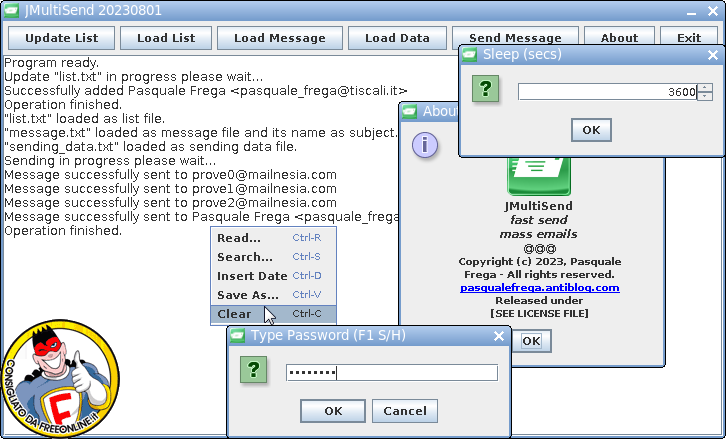
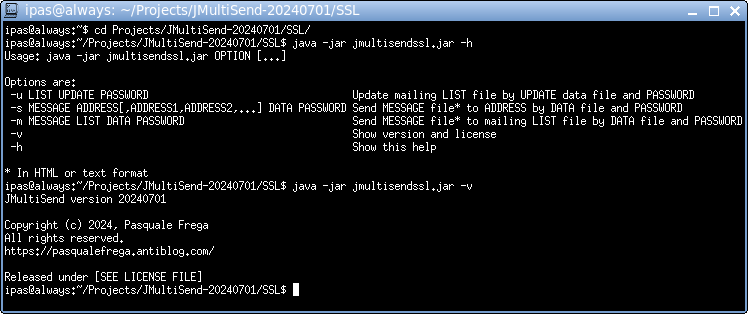
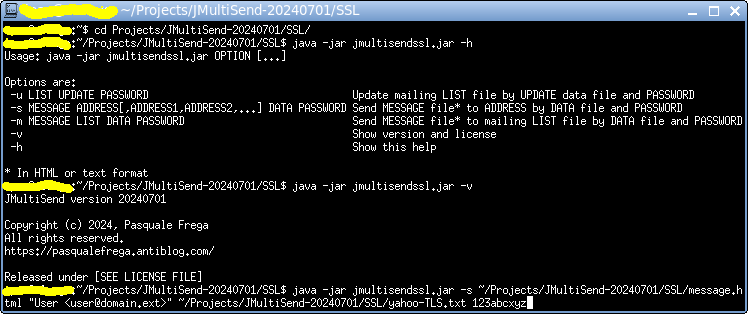
JMultiSend is a simple and fast solution to send mass emails (Bulk E-mail); it only needs to load the list of addresses, the message (HTML or TXT), the data and then send. It is possible also to manage mailing lists subscribtions simply by emails, to send personalized messages with the user name and to schedule delays up to 24h (86400 secs); all this also from command-line. Since it is developed in Java it is a cross-platform application and does not need installation but needs only the Java Virtual Machine (version 6 or higher) that, in the case, is very easy to download and install; click here to get it for any operating system.
The old outdated version of JMultiSend is freeware for personal use only, otherwise you must buy the professional license for commercial use, which includes the new updated release and is only valid for the current year, for only 10,00 Euro:

JMultiSend is hosted on Archive.org.
Read news, tips and howtos on the official Telegram channel.
Subscribe to the mailing list to receive info and updates by email.
P.S.
Click here to get the free and open-source release working without SSL hosted also on SourceForge.net.
FileCut is a simple easy-to-use cross-platform application to cut to a given line and then join any text file. It is also possible to join in normal or reverse order. Works also from command-line interface, e.g. java -jar filecut.jar -c file.txt . 10, to cut file.txt at line 10, and java -jar filecut.jar -j . >file.txt, to join files in the current directory in file.txt. FileCut is portable, does not need installation and is developed in Java, so needs the Java Virtual Machine (version 6 or higher) that, in the case, is very easy to download and install; click here to get it for any operating system.
FileCut is hosted on Archive.org and SourceForge.net.
DOWNLOAD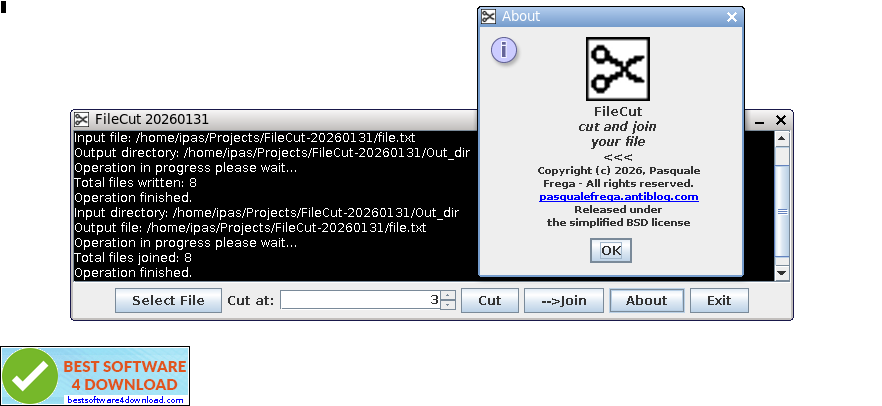
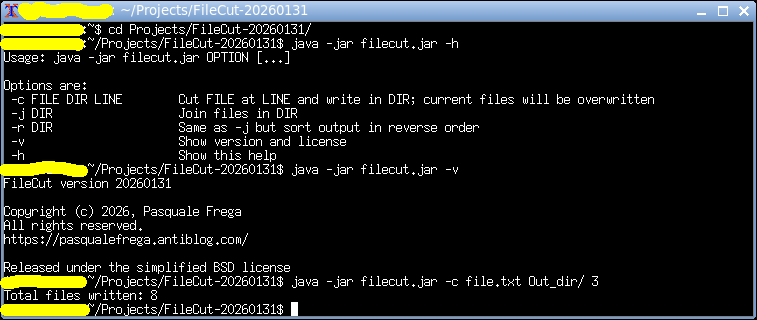
FileCut (and every thing with it) is released under the simplified BSD license:
Copyright (c) 2026, Pasquale Frega
All rights reserved.
Redistribution and use in source and binary forms, with or without modification, are permitted provided that the following conditions are met:
1. Redistributions of source code must retain the above copyright notice, this list of conditions and the following disclaimer.
2. Redistributions in binary form must reproduce the above copyright notice, this list of conditions and the following disclaimer in the documentation and/or other materials provided with the distribution.
THIS SOFTWARE IS PROVIDED BY THE COPYRIGHT HOLDERS AND CONTRIBUTORS "AS IS" AND ANY EXPRESS OR IMPLIED WARRANTIES, INCLUDING, BUT NOT LIMITED TO, THE IMPLIED WARRANTIES OF MERCHANTABILITY AND FITNESS FOR A PARTICULAR PURPOSE ARE DISCLAIMED. IN NO EVENT SHALL THE COPYRIGHT OWNER OR CONTRIBUTORS BE LIABLE FOR ANY DIRECT, INDIRECT, INCIDENTAL, SPECIAL, EXEMPLARY, OR CONSEQUENTIAL DAMAGES (INCLUDING, BUT NOT LIMITED TO, PROCUREMENT OF SUBSTITUTE GOODS OR SERVICES; LOSS OF USE, DATA, OR PROFITS; OR BUSINESS INTERRUPTION) HOWEVER CAUSED AND ON ANY THEORY OF LIABILITY, WHETHER IN CONTRACT, STRICT LIABILITY, OR TORT (INCLUDING NEGLIGENCE OR OTHERWISE) ARISING IN ANY WAY OUT OF THE USE OF THIS SOFTWARE, EVEN IF ADVISED OF THE POSSIBILITY OF SUCH DAMAGE.
YSticky is a portable cross-platform reminder / sticky note desktop application. It is very simple and its use recalls that of the real sticky notes in the following three steps:
YSticky is developed in Java so needs the Java Virtual Machine (version 6 or higher) that, in the case, is very easy to download and install; click here to get it for any operating system. It does not need installation since quickly creates and edits notes in the same directory of the executable.
YSticky is hosted on Archive.org and SourceForge.net.
DOWNLOAD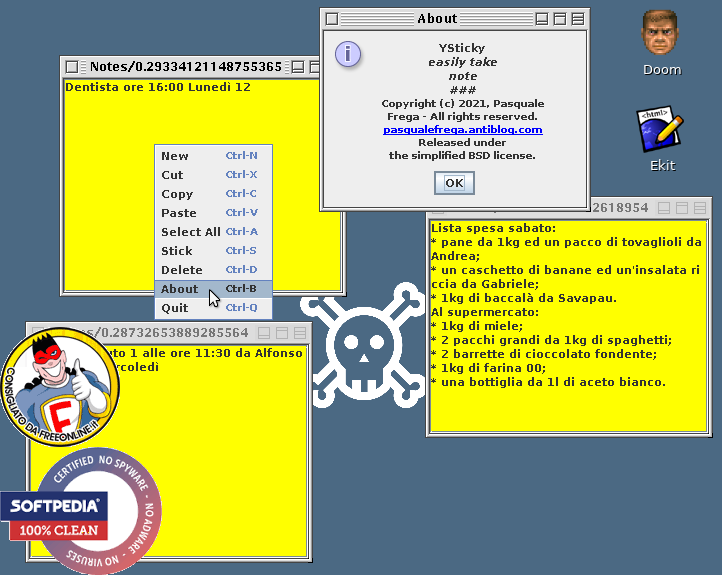
YSticky (and every thing with it) is released under the simplified BSD license:
Copyright (c) 2026, Pasquale Frega
All rights reserved.
Redistribution and use in source and binary forms, with or without modification, are permitted provided that the following conditions are met:
1. Redistributions of source code must retain the above copyright notice, this list of conditions and the following disclaimer.
2. Redistributions in binary form must reproduce the above copyright notice, this list of conditions and the following disclaimer in the documentation and/or other materials provided with the distribution.
THIS SOFTWARE IS PROVIDED BY THE COPYRIGHT HOLDERS AND CONTRIBUTORS "AS IS" AND ANY EXPRESS OR IMPLIED WARRANTIES, INCLUDING, BUT NOT LIMITED TO, THE IMPLIED WARRANTIES OF MERCHANTABILITY AND FITNESS FOR A PARTICULAR PURPOSE ARE DISCLAIMED. IN NO EVENT SHALL THE COPYRIGHT OWNER OR CONTRIBUTORS BE LIABLE FOR ANY DIRECT, INDIRECT, INCIDENTAL, SPECIAL, EXEMPLARY, OR CONSEQUENTIAL DAMAGES (INCLUDING, BUT NOT LIMITED TO, PROCUREMENT OF SUBSTITUTE GOODS OR SERVICES; LOSS OF USE, DATA, OR PROFITS; OR BUSINESS INTERRUPTION) HOWEVER CAUSED AND ON ANY THEORY OF LIABILITY, WHETHER IN CONTRACT, STRICT LIABILITY, OR TORT (INCLUDING NEGLIGENCE OR OTHERWISE) ARISING IN ANY WAY OUT OF THE USE OF THIS SOFTWARE, EVEN IF ADVISED OF THE POSSIBILITY OF SUCH DAMAGE.
YStickyE is a portable cross-platform reminder / sticky note desktop application with encryption. It is very simple to take encrypted notes in the following four steps:
YStickyE is developed in Java so needs the Java Virtual Machine (version 6 or higher) that, in the case, is very easy to download and install; click here to get it for any operating system. It does not need installation since quickly creates and edits notes in the same directory of the executable. It is freeware for personal use only.
YStickyE encrypts text using Blowfish algorithm with 256 bit key. It is free for only five notes, if you want the full version please send me a free donation from here to get the archive password.
YStickyE is hosted on Archive.org.
DOWNLOAD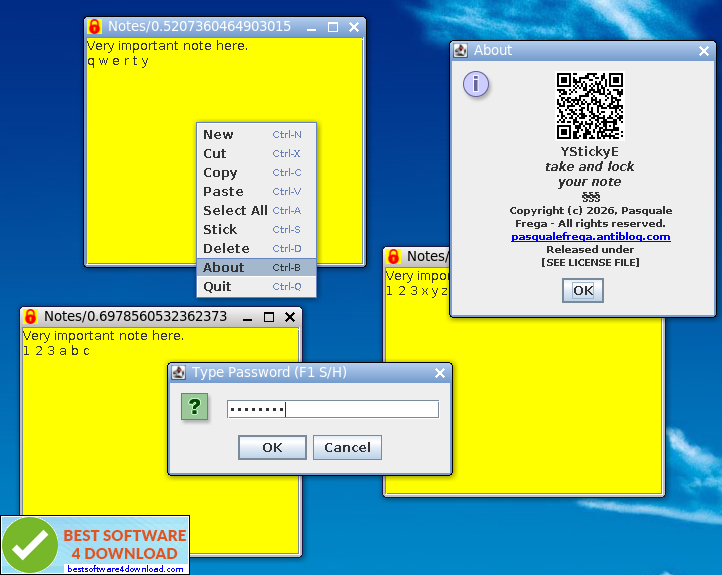
ZipLock is a simple easy-to-use cross-platform backup / compression application to zip files and folders with password using AES algorithm with 128 or 256 bit key; includes also a secure delete feature. It is developed in Java so needs the Java Virtual Machine (version 6 or higher) that, in the case, is very easy to download and install; click here to get it for any operating system. ZipLock does not need installation and is mainly intendend to be used on USB storage devices because quickly creates and manages backup archives in the same directory of the executable. It is freeware for personal use only.
ZipLock works with 128 bit key, if you want the safer release with 256 bit key please send me a free donation from here to get the archive password.
ZipLock is hosted on Archive.org.
USB storage devices sellers who would like to sell them with ZipLock to encrease sales, please contact me from here.
DOWNLOAD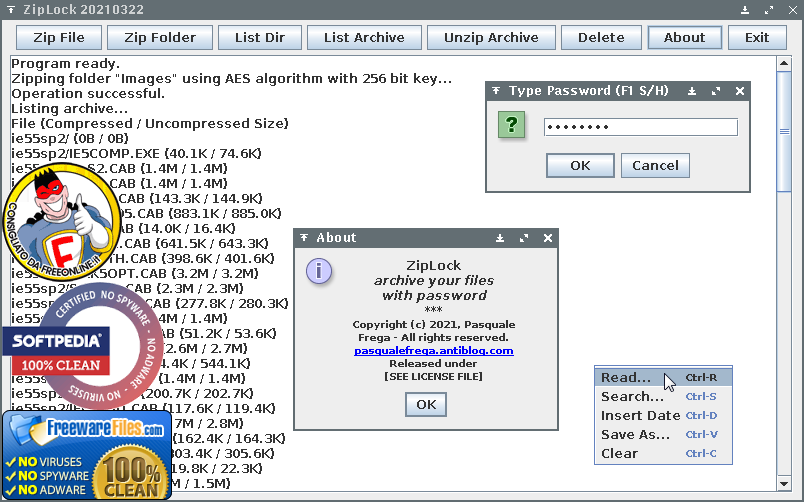
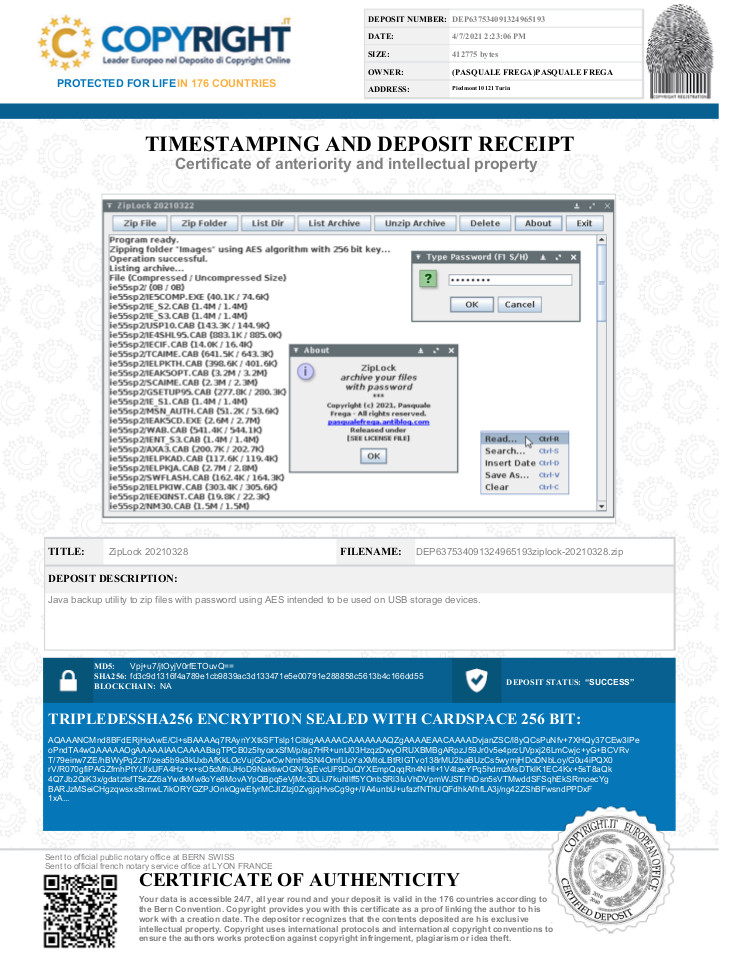
Developed using Zip4j library by Srikanth Reddy Lingala released under the Apache License 2.0.
There are security software available online, free or not, that involves creating a hidden and encrypted volume on USB sticks. They say it's safe, however anyone who inserts a 16GB USB stick and sees that the mounted volume is only 12GB, immediately understands that there is something hidden. Discovering and creating an image of a hidden volume is very simple, it only takes a little time. At the end the result will be an encrypted file on your hard disk, which is equivalent to a simple zip archive, often encrypted with the same AES algorithm. So the question arises: why pay for these difficult and inconvenient solutions and then have the same level of security? A simple encrypted zip archive (or rather a double encrypted zip archive, e.g. folder -> folder.zip -> folder.zip.zip) in a hidden folder is not much different, in fact, at first glance it is more difficult to discover a hidden folder on a volume with many files than a hidden volume.
This tutorial explains how to easily create a hidden directory inside any FAT-formated USB storage device. Please follow the instructions:
Now you have a hidden directory called .data where you can copy documents, files and applications and keep them away from prying eyes. To show that directory on GNU/Linux with Gnome desktop, in the Nautilus file manager simply press Ctrl+H, press again to hide it anew. A similar way on macOS, in the Finder file manager press Command + Shift + . (full stop/period), press again to hide it anew. On recent Windows follow the illustration below.
.jpg)
Secure USB (and every thing with it) is released under the simplified BSD license:
Copyright (c) 2026, Pasquale Frega
All rights reserved.
Redistribution and use in source and binary forms, with or without modification, are permitted provided that the following conditions are met:
1. Redistributions of source code must retain the above copyright notice, this list of conditions and the following disclaimer.
2. Redistributions in binary form must reproduce the above copyright notice, this list of conditions and the following disclaimer in the documentation and/or other materials provided with the distribution.
THIS SOFTWARE IS PROVIDED BY THE COPYRIGHT HOLDERS AND CONTRIBUTORS "AS IS" AND ANY EXPRESS OR IMPLIED WARRANTIES, INCLUDING, BUT NOT LIMITED TO, THE IMPLIED WARRANTIES OF MERCHANTABILITY AND FITNESS FOR A PARTICULAR PURPOSE ARE DISCLAIMED. IN NO EVENT SHALL THE COPYRIGHT OWNER OR CONTRIBUTORS BE LIABLE FOR ANY DIRECT, INDIRECT, INCIDENTAL, SPECIAL, EXEMPLARY, OR CONSEQUENTIAL DAMAGES (INCLUDING, BUT NOT LIMITED TO, PROCUREMENT OF SUBSTITUTE GOODS OR SERVICES; LOSS OF USE, DATA, OR PROFITS; OR BUSINESS INTERRUPTION) HOWEVER CAUSED AND ON ANY THEORY OF LIABILITY, WHETHER IN CONTRACT, STRICT LIABILITY, OR TORT (INCLUDING NEGLIGENCE OR OTHERWISE) ARISING IN ANY WAY OUT OF THE USE OF THIS SOFTWARE, EVEN IF ADVISED OF THE POSSIBILITY OF SUCH DAMAGE.
randomm.h is a C library to generate sequences of pseudo-random numbers by using a seed, which is a positive integer. It is easy to port into other languages, this is an example in JavaScript, that is used by this pseudo-random numbers generator and this password generator.
randomm.h:
/* randomm.h - a C library to generate pseudo-random numbers */


/* Copyright (C) 2019 Pasquale Frega */

/* All rights reserved */

/* https://pasqualefrega.antiblog.com/ */


/* Released under the simplified BSD license */


/* last edit: 13-Jun-2019 */


/* begin */


/* Maximum random number (try to change only with another odd number) */


#define RAND_MAX 32767


unsigned int SEED = 1;

unsigned int TIME = 1;


/* Change SEED value */


void srand(unsigned int seed) {

 SEED = seed;

 TIME = 1;

}


/* Return a pseudo-random number */


int rand(void) {

 SEED += TIME;

 if(SEED != RAND_MAX) {

  while(SEED < RAND_MAX)

   SEED *= SEED + 1;

  while(SEED >= RAND_MAX)

   SEED -= RAND_MAX;

 }

 TIME++;

 return((int)SEED);

}


/* end */
#include <stdio.h>

#include "randomm.h"


int main(void) {

 int _count;


 srand(20190613);


 printf("10 numbers from 0 to 32767:\n");

 for(_count = 0; _count <= 9; _count++)

  printf("%d\n", rand());


 /* Using % operator changes the range and increases random */


 printf("10 numbers from 0 to 32767:\n");

 for(_count = 0; _count <= 9; _count++)

  printf("%d\n", (rand() % 32768));


 printf("10 numbers from 0 to 10:\n");

 for(_count = 0; _count <= 9; _count++)

  printf("%d\n", (rand() % 11));


 printf("10 numbers from 5 to 10:\n");

 for(_count = 0; _count <= 9; _count++)

  printf("%d\n", ((rand() % 6) + 5));


 printf("10 numbers from -5 to 5:\n");

 for(_count = 0; _count <= 9; _count++)

  printf("%d\n", ((rand() % 11) - 5));


 printf("10 numbers from 0.0 to 1.0:\n");

 for(_count = 0; _count <= 9; _count++)

  printf("%.1f\n", ((rand() % 11) * 0.1));


 return(0);

}
randomm.h (and every thing with it) is released under the simplified BSD license:
Copyright (c) 2019, Pasquale Frega
All rights reserved.
Redistribution and use in source and binary forms, with or without modification, are permitted provided that the following conditions are met:
1. Redistributions of source code must retain the above copyright notice, this list of conditions and the following disclaimer.
2. Redistributions in binary form must reproduce the above copyright notice, this list of conditions and the following disclaimer in the documentation and/or other materials provided with the distribution.
THIS SOFTWARE IS PROVIDED BY THE COPYRIGHT HOLDERS AND CONTRIBUTORS "AS IS" AND ANY EXPRESS OR IMPLIED WARRANTIES, INCLUDING, BUT NOT LIMITED TO, THE IMPLIED WARRANTIES OF MERCHANTABILITY AND FITNESS FOR A PARTICULAR PURPOSE ARE DISCLAIMED. IN NO EVENT SHALL THE COPYRIGHT OWNER OR CONTRIBUTORS BE LIABLE FOR ANY DIRECT, INDIRECT, INCIDENTAL, SPECIAL, EXEMPLARY, OR CONSEQUENTIAL DAMAGES (INCLUDING, BUT NOT LIMITED TO, PROCUREMENT OF SUBSTITUTE GOODS OR SERVICES; LOSS OF USE, DATA, OR PROFITS; OR BUSINESS INTERRUPTION) HOWEVER CAUSED AND ON ANY THEORY OF LIABILITY, WHETHER IN CONTRACT, STRICT LIABILITY, OR TORT (INCLUDING NEGLIGENCE OR OTHERWISE) ARISING IN ANY WAY OUT OF THE USE OF THIS SOFTWARE, EVEN IF ADVISED OF THE POSSIBILITY OF SUCH DAMAGE.
led is a simple and easy-to-use but yet powerful line-oriented text editor; almost everything in this site has been edited or developed by it. It is written in Urn Lisp and compiled to Lua, so it is available for every platform where Lua (version 5.1 or higher) is available as well; however some special features are available only with Lua 5.1 (or LuaJIT) on AmigaOS, MorphOS, AROS and UNIX with XTerm.
It is chosen by 1000+ system administrators and developers as their every-day editor.
The latest release now supports also scripts for text processing.
led is hosted on Archive.org and also on SourceForge.net.
DOWNLOAD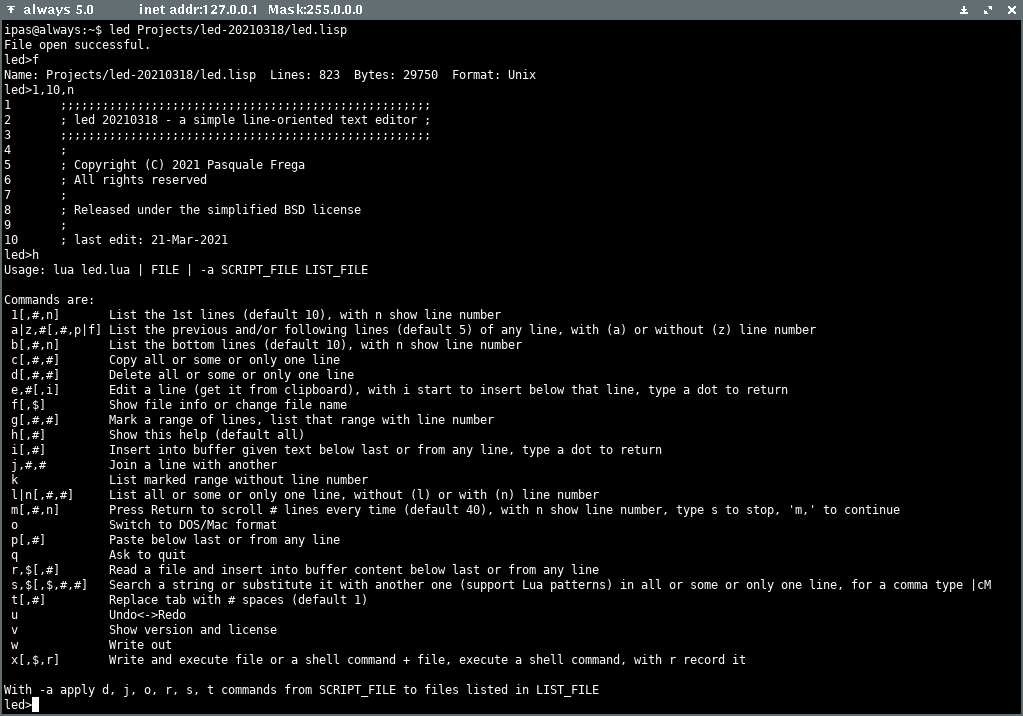
led (and every thing with it) is released under the simplified BSD license:
Copyright (c) 2021, Pasquale Frega
All rights reserved.
Redistribution and use in source and binary forms, with or without modification, are permitted provided that the following conditions are met:
1. Redistributions of source code must retain the above copyright notice, this list of conditions and the following disclaimer.
2. Redistributions in binary form must reproduce the above copyright notice, this list of conditions and the following disclaimer in the documentation and/or other materials provided with the distribution.
THIS SOFTWARE IS PROVIDED BY THE COPYRIGHT HOLDERS AND CONTRIBUTORS "AS IS" AND ANY EXPRESS OR IMPLIED WARRANTIES, INCLUDING, BUT NOT LIMITED TO, THE IMPLIED WARRANTIES OF MERCHANTABILITY AND FITNESS FOR A PARTICULAR PURPOSE ARE DISCLAIMED. IN NO EVENT SHALL THE COPYRIGHT OWNER OR CONTRIBUTORS BE LIABLE FOR ANY DIRECT, INDIRECT, INCIDENTAL, SPECIAL, EXEMPLARY, OR CONSEQUENTIAL DAMAGES (INCLUDING, BUT NOT LIMITED TO, PROCUREMENT OF SUBSTITUTE GOODS OR SERVICES; LOSS OF USE, DATA, OR PROFITS; OR BUSINESS INTERRUPTION) HOWEVER CAUSED AND ON ANY THEORY OF LIABILITY, WHETHER IN CONTRACT, STRICT LIABILITY, OR TORT (INCLUDING NEGLIGENCE OR OTHERWISE) ARISING IN ANY WAY OUT OF THE USE OF THIS SOFTWARE, EVEN IF ADVISED OF THE POSSIBILITY OF SUCH DAMAGE.
JSchemePlus is a hack of Jscheme 1.4 by Peter Norvig. It is basically the same, however it allows to redistribute a script in an executable JAR file of only ~40K, simply make a copy of runtime.jar, e.g. cp runtime.jar my-jar.jar, name the script as main.scm and insert into this JAR, e.g. zip -u my-jar.jar main.scm, then execute it, e.g. java -jar my-jar.jar
JSchemePlus does not get command-line arguments as list of scripts to execute, only the first one is executed, the others are passed to this script and stored as list of strings in *arguments*. It implements all of R4RS with a lot of additional functions, like: (execute command) (random) (sequence from up-to step) (split list element) (string-split string sub-string) (read-all-from-file file) (write-to-file file data) (file-size file) etc... For the complete list read the HELP file or type (help).
JSchemePlus needs only the Java Virtual Machine (version 6 or higher) that, in the case, is very easy to download and install; click here to get it for any operating system.
About Scheme, it is a Lisp dialect that allows to write programs and scripts quickly and easly. It is a different language, even compared to other Lisps; it is not difficult, only a bit different. The following is an example of recursion:
(define (sequence from up-to step)

 (if (and (integer? from) (integer? up-to) (integer? step) (<= from up-to) (positive? step))

  (let ((_sequence '()))

   (define (loop _var)

    (if (< _var from)

     _sequence

     (begin

      (set! _sequence (cons _var _sequence))

      (loop (- _var step))

     )

    )

   )

   (loop up-to)

  )

  '()

 )

)
The following is an example of iteration:
(for-each (lambda (_num)

 (if (odd? _num)

  (display _num)

  (newline)

 )

) (sequence 1 10 1))


1

3

5

7

9

()
It checks each number from 1 to 10, if this is odd it prints this, otherwise it prints a newline. Finally, it returns nothing (empty list). For more information and examples, see the reference documentation.
JSchemePlus is hosted on SourceForge.net.
DOWNLOADJSchemePlus (and every thing with it) is released under the simplified BSD license:
Copyright (c) 2025, Pasquale Frega
All rights reserved.
Redistribution and use in source and binary forms, with or without modification, are permitted provided that the following conditions are met:
1. Redistributions of source code must retain the above copyright notice, this list of conditions and the following disclaimer.
2. Redistributions in binary form must reproduce the above copyright notice, this list of conditions and the following disclaimer in the documentation and/or other materials provided with the distribution.
THIS SOFTWARE IS PROVIDED BY THE COPYRIGHT HOLDERS AND CONTRIBUTORS "AS IS" AND ANY EXPRESS OR IMPLIED WARRANTIES, INCLUDING, BUT NOT LIMITED TO, THE IMPLIED WARRANTIES OF MERCHANTABILITY AND FITNESS FOR A PARTICULAR PURPOSE ARE DISCLAIMED. IN NO EVENT SHALL THE COPYRIGHT OWNER OR CONTRIBUTORS BE LIABLE FOR ANY DIRECT, INDIRECT, INCIDENTAL, SPECIAL, EXEMPLARY, OR CONSEQUENTIAL DAMAGES (INCLUDING, BUT NOT LIMITED TO, PROCUREMENT OF SUBSTITUTE GOODS OR SERVICES; LOSS OF USE, DATA, OR PROFITS; OR BUSINESS INTERRUPTION) HOWEVER CAUSED AND ON ANY THEORY OF LIABILITY, WHETHER IN CONTRACT, STRICT LIABILITY, OR TORT (INCLUDING NEGLIGENCE OR OTHERWISE) ARISING IN ANY WAY OUT OF THE USE OF THIS SOFTWARE, EVEN IF ADVISED OF THE POSSIBILITY OF SUCH DAMAGE.
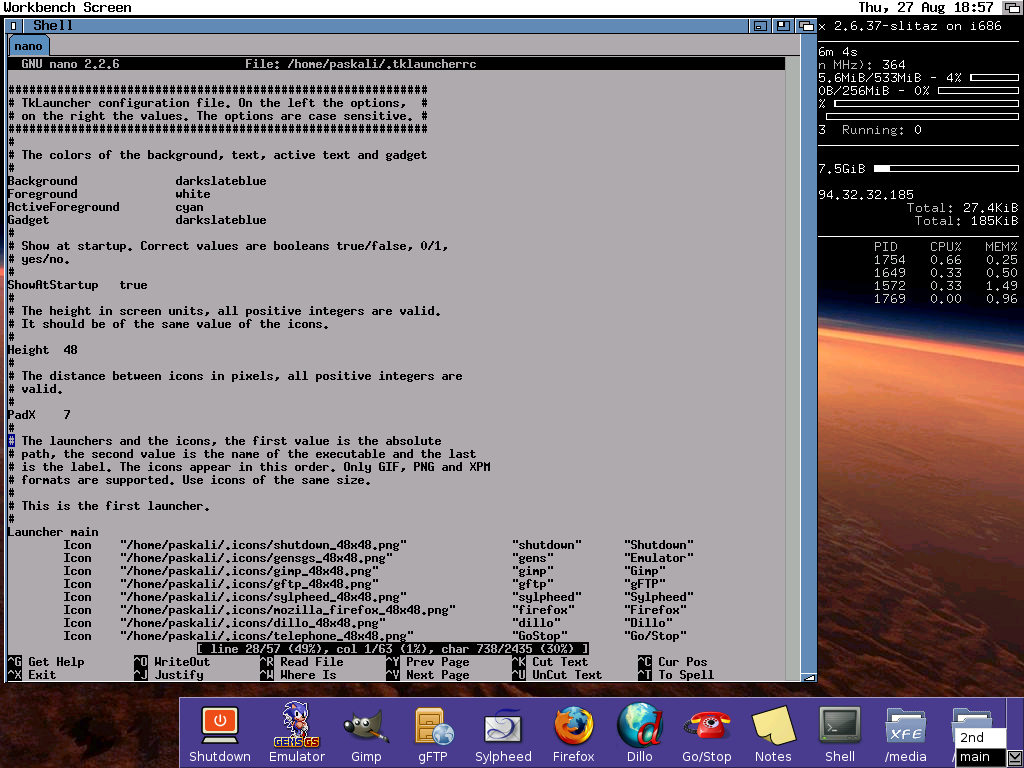
TkLauncher is a small desktop launcher for GNU/Linux, but easy to compile also elsewhere. It is very simple, provides a small gadget on the bottom-right corner of the screen where you clicking appears a launcher with some icons. TkLauncher reads a configuration file on your home directory, .tklauncherrc; at the first running it creates one if does not exist. Edit this file to set it.
I have wrote TkLauncher mainly for my prefered window manager, amiwm, so it is tested especially with this; however it should work also with the others, I think, without problems. It is different but recalls, more or less, AmiDock on AmigaOS 3.x.
TkLauncher is written in Tcl/Tk and C and is distribuited as a classic tarball. It is light and fast so you can use it also on old computers with few resources. It is nice and works fine, however sometimes after you have dragged the top bar of the amiwm, it does not work any more (I do not know why) and you have to reset amiwm. Also, don't start launcher names in capital letters, this usually reports error. Finally, I provide also a small module to use with this window manager.
History:
* 26-Jun-2018 (v0.32)
Solved a bug about the quick launch feature;
* 21-May-2016
Available the tcl2c application;
Small update in the README file;
* 10-Feb-2016 (v0.31)
Standard error is redirected to /tmp/tklauncher.log, now is more easy to check possible errors;
* 01-Jan-2016 (v0.3)
Support fonts;
Quick launch feature;
Global settings by ~/.wishrc;
Solved some minor bugs;
* 02-Sep-2015
Everything has been translated to C, now is possible to compile and install as usual;
* 29-Aug-2015
Revision of version numbers;
* 28-Aug-2015 (v0.2)
Shrink/unshrink with a double click, now emulation of AmiDock is near at 100%;
* 01-Aug-2015 (v0.16)
Small cosmetic changes, now look more like the original AmiDock;
Solved some minor bugs;
* 17-May-2015 (v0.15)
Second stable release;
No more based on TkPNG but on TkImg;
Solved the memory leak bug;
Now also XPM format is supported;
Solved some minor bugs;
* 12-May-2015 (v0.13b)
Auto-invoke the selected launcher from launcher menu;
Show Amiga logo;
* 04-May-2015 (v0.12b)
Added launcher menu;
* 25-Jan-2015 (v0.1)
First stable release;
-TkLauncher (and every thing with it) is released under the simplified BSD license:
Copyright (c) 2016, Pasquale Frega
All rights reserved.
Redistribution and use in source and binary forms, with or without modification, are permitted provided that the following conditions are met:
1. Redistributions of source code must retain the above copyright notice, this list of conditions and the following disclaimer.
2. Redistributions in binary form must reproduce the above copyright notice, this list of conditions and the following disclaimer in the documentation and/or other materials provided with the distribution.
THIS SOFTWARE IS PROVIDED BY THE COPYRIGHT HOLDERS AND CONTRIBUTORS "AS IS" AND ANY EXPRESS OR IMPLIED WARRANTIES, INCLUDING, BUT NOT LIMITED TO, THE IMPLIED WARRANTIES OF MERCHANTABILITY AND FITNESS FOR A PARTICULAR PURPOSE ARE DISCLAIMED. IN NO EVENT SHALL THE COPYRIGHT OWNER OR CONTRIBUTORS BE LIABLE FOR ANY DIRECT, INDIRECT, INCIDENTAL, SPECIAL, EXEMPLARY, OR CONSEQUENTIAL DAMAGES (INCLUDING, BUT NOT LIMITED TO, PROCUREMENT OF SUBSTITUTE GOODS OR SERVICES; LOSS OF USE, DATA, OR PROFITS; OR BUSINESS INTERRUPTION) HOWEVER CAUSED AND ON ANY THEORY OF LIABILITY, WHETHER IN CONTRACT, STRICT LIABILITY, OR TORT (INCLUDING NEGLIGENCE OR OTHERWISE) ARISING IN ANY WAY OUT OF THE USE OF THIS SOFTWARE, EVEN IF ADVISED OF THE POSSIBILITY OF SUCH DAMAGE.
RetroLook is a simple window manager for X11 wrote in Tcl/Tk and C. It is based on TKWM that, where possible, has been cleaned and fixed. RetroLook makes your desktop looking like it was in the '80 years. It recalls AmigaOS 1.x, in particular the 1.4 (a version never released), because it had planned the maximized button. It supports also sloppy focus, close button, stack buttons and resize button. Clicking on the title bar or on the right bar also does raise and focus. There is nothing to configure, no wallpaper, no color scheme, no fonts, etc... Also it does not support virtual desktops. There is not plan to support such things. It works only with a simple menu file in the home directory, ~/.retrolookmenu, with simple items, no submenu's.
It needs: Xop 0.4, Rootwin 0.4, Foreignwin 0.1; may be also tcl2c; Tkimg is not mandatory.
May be usefull for coding and testing purpose.
DOWNLOAD
History:
* 26-Jun-2016 (v20160626)
No more forced to click on the close gadget;
* 01-Jun-2016 (v20160601)
The initial window size and position are better recognized;
Right click to show the active tasks;
Bit improvement in the cursor theme;
* 25-May-2016 (v20160513)
First public release;
-RetroLook (and every thing with it) is released under the simplified BSD license:
Copyright (c) 2016, Pasquale Frega
All rights reserved.
Redistribution and use in source and binary forms, with or without modification, are permitted provided that the following conditions are met:
1. Redistributions of source code must retain the above copyright notice, this list of conditions and the following disclaimer.
2. Redistributions in binary form must reproduce the above copyright notice, this list of conditions and the following disclaimer in the documentation and/or other materials provided with the distribution.
THIS SOFTWARE IS PROVIDED BY THE COPYRIGHT HOLDERS AND CONTRIBUTORS "AS IS" AND ANY EXPRESS OR IMPLIED WARRANTIES, INCLUDING, BUT NOT LIMITED TO, THE IMPLIED WARRANTIES OF MERCHANTABILITY AND FITNESS FOR A PARTICULAR PURPOSE ARE DISCLAIMED. IN NO EVENT SHALL THE COPYRIGHT OWNER OR CONTRIBUTORS BE LIABLE FOR ANY DIRECT, INDIRECT, INCIDENTAL, SPECIAL, EXEMPLARY, OR CONSEQUENTIAL DAMAGES (INCLUDING, BUT NOT LIMITED TO, PROCUREMENT OF SUBSTITUTE GOODS OR SERVICES; LOSS OF USE, DATA, OR PROFITS; OR BUSINESS INTERRUPTION) HOWEVER CAUSED AND ON ANY THEORY OF LIABILITY, WHETHER IN CONTRACT, STRICT LIABILITY, OR TORT (INCLUDING NEGLIGENCE OR OTHERWISE) ARISING IN ANY WAY OUT OF THE USE OF THIS SOFTWARE, EVEN IF ADVISED OF THE POSSIBILITY OF SUCH DAMAGE.
The King James Version (KJV), also known as the King James Bible (KJB) or simply the Authorized Version (AV), is an English translation of the Christian Bible for the Church of England, begun in 1604 and completed/published in 1611 under the sponsorship of King James I. The books of the King James Version include the 39 books of the Old Testament, an intertestamental section containing 14 books of the Apocrypha, and the 27 books of the New Testament.
Yet today it is one of the best and more important English version of the Christian Bible.
Because its age now it is public domain (copyright free).
This release is the first version of the 1611 in EPUB and MOBI formats for Amazon Kindle and other eBook readers and tablets; for other devices please download and install FBReader. It is very easy and very comfortable to read because it includes hyperlinks for every book, chapter and verse.
It is hosted on Archive.org.
DOWNLOADIl Sutra del Cuore della Perfezione della Saggezza o Sutra del Cuore (sanscrito: Prajñāpāramitā Hṛdaya) è un Sutra Mahāyāna del gruppo della Prajñāpāramitā, molto conosciuto e diffuso nei paesi di tradizione Mahāyāna per la sua brevità e densità di significato. Si ritiene che sia stato composto intorno al I secolo d.C. nell'Impero Kushan. Consiste di soli quattordici śloka (versi) nella versione in sanscrito e 260 caratteri nella versione cinese più diffusa. L'argomento del Sutra è la formulazione della dottrina della "vacuità" (o letteralmente: "vuotezza", sanscrito śūnyatā) ovvero la insostanzialità (o non esistenza intrinseca) di tutti i fenomeni. Il Sutra si apre con l'esperienza della "visione profonda" ottenuta dal Bodhisattva della Compassione Avalokiteśvara. La "visione profonda" rivela l'insostanzialità (śūnyatā) dei cinque skandha (elementi): forma (o materia, rūpa), sensazione (vedanā), percezione (saṁjñā), discriminazione (aggregati o costrutti mentali, samskārā), e coscienza (vijñāna); cioè tutte le parti in cui tradizionalmente è articolata, secondo la filosofia buddhista, la realtà fisica e psichica.
Il Sutra del Diamante è un celebre breve Sutra Mahāyāna della classe dei Sutra della Prajñāpāramitā. Nelle grotte di Mogao a Dunhuang, l'archeologo britannico Aurel Stein trovò nel 1907 una copia del Sutra del Diamante nella traduzione cinese di Kumārajīva che risultò essere il più antico testo a stampa oggi esistente, risultando quindi il testo completo a stampa più antico con datazione certa, precedendo la Bibbia di Gutenberg di ben 587 anni. In esso il Buddha espone all'anziano discepolo Subhūti quale sia la pratica che deve seguire chi volesse perseguire la via del Bodhisattva.
Queste versioni in Italiano sono in formato EPUB e MOBI per Amazon Kindle ed altri eBook reader e tablet; diversamente è possibile scaricare ed installare FBReader. Sono molto facili da leggere in quanto includono un comodo indice con hyperlink.
DOWNLOADIf You like any of my project, please consider to make me a donation:

A new free online tool, SubLin, and two new free applications, FileCut and YStickyE, are available.
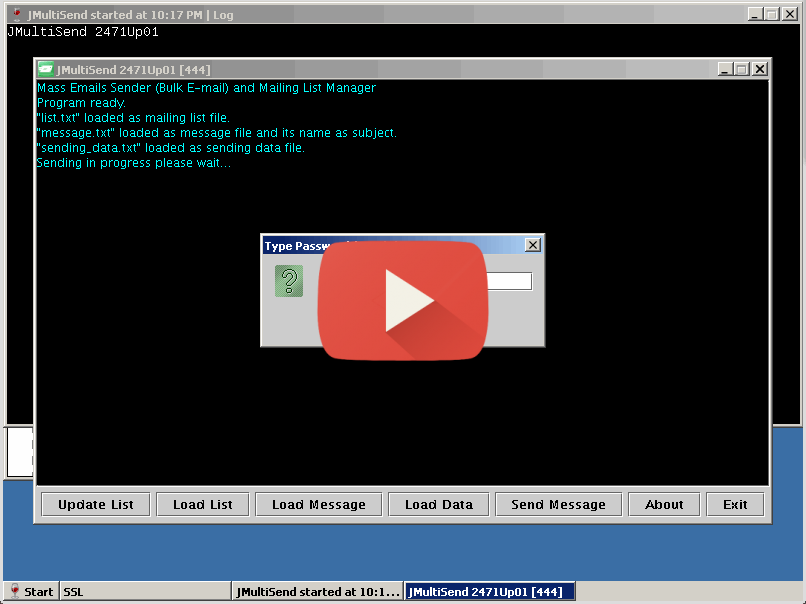
The new release of JMultiSend is available, but only for professional use; for security reasons, it is highly recommended instead of the old outdate releases.
Changes in 2471Up01 absent in the freeware version:
* Characters in messages are better recognized;
* Improved the efficiency and security of the automatic initial tests;
* Load and send messages faster;
* It shows the real-time progress of the session in the start/log window before reporting everything in the output window;
* It is possible to add and remove an address from any email by indicating as subject the string "any";
* Better reporting of unsent emails, and, in general, everything else;
* Context menu on the found page to quickly copy and select all;
* It is possible to choose how many instances to launch at the same time, see the progress of the sessions in real-time in a single window while everything is automatically saved in the log file (only on GNU/Linux, macOS and other UNIX);
* Added session stop button;
* When sending, ability to keep or remove the user names from the mailing list;
* When update, ability to get only the sender's address without the user name;
* Ability to sleep the update session;
* Shows countdown timer while sleeping;
* ${user} could also be replaced by the value of the JMS_USERDEF enviroment variable, if this is set;
* Asks before clearing the output;
* Improved usage by command line interface;
* Ability to insert the user name in the subject line (not recommended);
* Rebuilt with new updated libraries.
A new free online tool is available, DupRem.
A new free online service is available, QuickPoll.
Two new free online services are available, Link2Mail and NewURL.
New site with new look and functionality.






| [Subject] | |
| [Body] | |
By checking here and submitting form you authorize the processing of your data to receive promotions and communications reserved for you from Pasquale Frega, mainly for marketing and advertising purposes.
Your data will be stored and managed following the latest GDPR; Pasquale Frega hereby declares to be the data controller/processor and data protection officer.